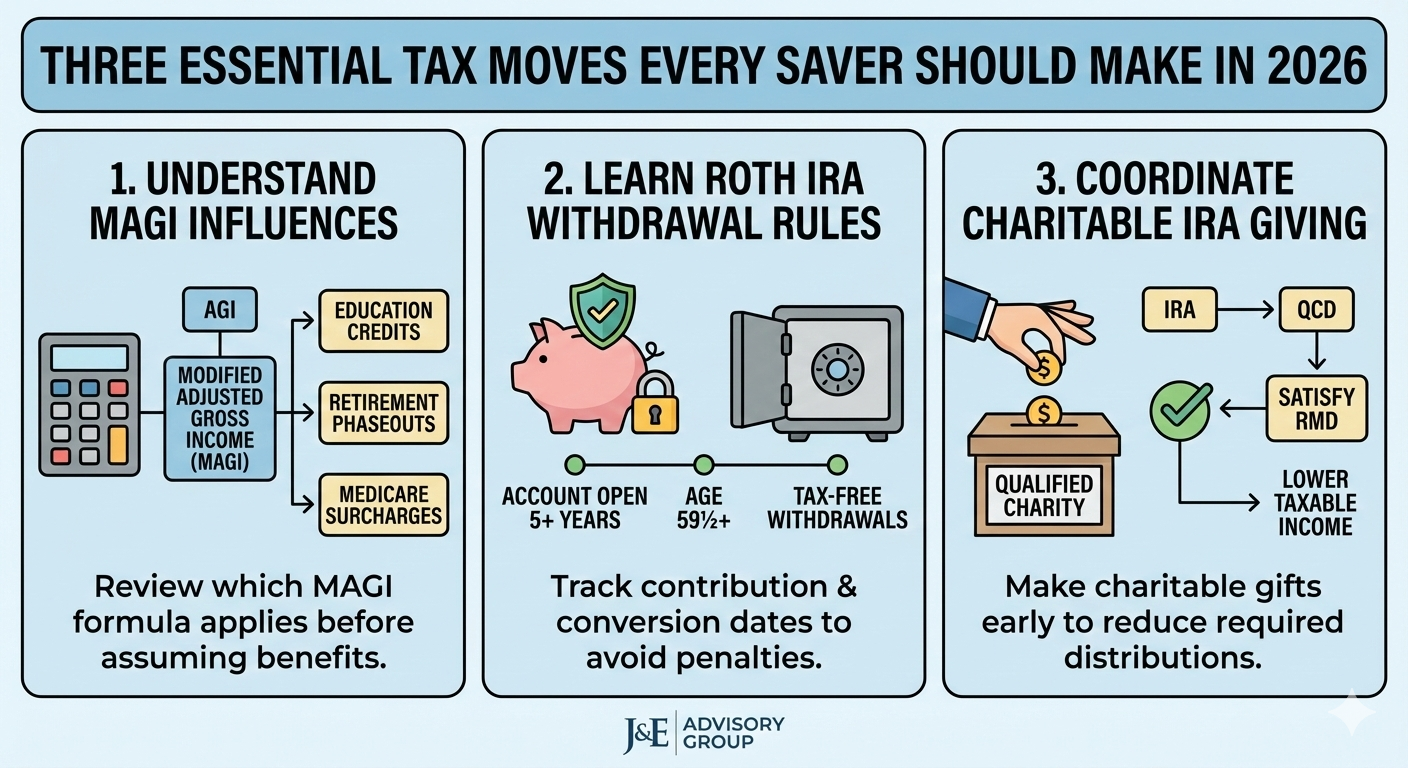
Three Essential Tax Moves Every Saver Should Make in 2026
Learn three essential 2026 tax resolutions that help you understand MAGI, manage Roth IRA withdrawals, and use charitable IRA giving to reduce taxable income.
As individuals and businesses prepare for the 2026 tax season, proactive tax planning becomes essential. Understanding how income thresholds work, knowing the rules that govern Roth IRA withdrawals, and using charitable strategies effectively can all reduce unnecessary tax exposure. At J&E Advisory Group, we frequently guide clients through these complex areas, especially when hidden tax triggers or timing rules can significantly affect long-term financial outcomes.
The three resolutions below highlight areas that often cause confusion yet offer meaningful opportunities for tax savings when handled correctly.
1. Understand How MAGI Influences Key Tax Benefits
Many taxpayers rely on adjusted gross income to determine eligibility for credits, deductions, or additional taxes. However, modified adjusted gross income often determines the real qualification thresholds. MAGI is not a single calculation. Instead, the tax code uses different versions of MAGI depending on the specific benefit or limitation.
Why MAGI Matters in 2026
- MAGI is used to determine eligibility for certain deductions, credits, and surcharges.
- Each tax provision can require different add‑backs to AGI.
- Misunderstanding MAGI can cause taxpayers to lose benefits unintentionally.
Common Scenarios Where MAGI Applies
- Eligibility for education credits.
- Phaseouts for certain retirement contributions.
- Calculation of income-based Medicare surcharges.
- Determining whether Social Security income becomes taxable.
Key Insight for 2026
Some new tax incentives for seniors, employees receiving tips, and workers earning overtime do not require adding back municipal bond interest when calculating MAGI. Instead, they focus on narrow categories of foreign earned income or income from certain United States territories.
Tax Resolution: Review which MAGI formula applies before assuming you qualify for or lose a particular tax benefit.
2. Learn the Rules Governing Tax-Free Roth IRA Withdrawals
Roth IRAs remain one of the most powerful tax-planning tools due to their potential for tax-free growth. Yet the withdrawal rules are detailed and sometimes misunderstood. Missteps can result in income taxes or an early distribution penalty.
The Core Requirements for Tax-Free Withdrawals
- The account must have been open for at least five years.
- The account owner must be at least age fifty‑nine and a half.
Important Considerations for 2026
- Conversions and contributions follow different timing rules.
- Withdrawals are treated in a required order that can protect taxpayers from triggering tax on earnings.
- Rollovers from Roth 401(k) plans follow separate five‑year rules.
Practical Example
A saver who converts a traditional IRA at an older age can withdraw the converted principal without penalty. However, earnings on that amount may still require a full five‑year waiting period before they become tax-free. The same applies to heirs inheriting these accounts.
Tax Resolution: Track contribution dates, conversion dates, and rollover history to avoid accidental taxation on Roth IRA withdrawals.
3. Coordinate Charitable IRA Giving with Required Minimum Distributions
For individuals age seventy and a half or older, a qualified charitable distribution is a powerful way to donate to charity while lowering taxable income.
Why QCDs Are so Effective
- A QCD allows taxpayers to transfer funds from an IRA directly to a qualified charity.
- The amount donated does not increase adjusted gross income.
- If the taxpayer is age seventy‑three or older, the QCD can satisfy part or all of the required minimum distribution.
Rules to Keep in Mind
-Only the first dollars withdrawn from an IRA count toward the annual required distribution. -If a taxpayer takes the full RMD before making a charitable gift, the later QCD will not reduce taxable income for that year. -To ensure the QCD counts toward the required distribution, it must occur before the RMD is fully satisfied.
Example Scenario
A taxpayer with a fifty thousand dollar RMD could donate ten thousand dollars through a QCD and then withdraw forty thousand dollars to complete the rest of the RMD. If the taxpayer already withdrew the full fifty thousand dollars before giving to charity, the QCD no longer offsets taxable income for the year.
Tax Resolution: Make charitable IRA gifts early in the year if you want them to reduce your required distribution.
Understanding income calculations, withdrawal rules, and charitable strategies can significantly improve your tax outcome for 2026. For high-income professionals, retirees, and business owners, these topics play a major role in tax efficiency and long-term wealth preservation.
If you want a customized plan that aligns with your financial goals, our team at J&E Advisory Group can help you analyze your specific situation and implement the strategies that provide the greatest tax advantage.